
What is Chinese New Year and its significance?
Chinese New Year, also known as Lunar New Year or Spring Festival (春节), is a 15-day celebration full of red decorations, fireworks, feasts, dragon dances, and family reunions. This celebration starts with the second new moon after the winter solstice, which typically falls between January 21st and February 19th. This year, Chinese New Year is on February 17th.
On Chinese New Year’s Eve (除夕), families and relatives gather to have a large feast.
On the 15th and final day of Chinese New Year, the Lantern Festival is held, where people eat tangyuan (汤圆), a dessert of sweet glutinous rice balls in soup, and children walk around at night while carrying lanterns to mark the end of the two-week festival.
History
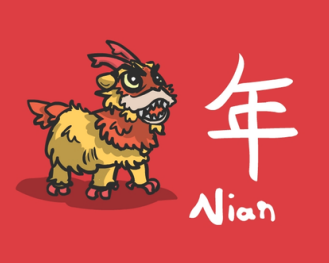
Chinese New Year has a history of more than 3500 years, starting in the Shang dynasty (商朝) where people worshiped ancestors and deities during the beginning or end of the year. There is also a famous story of a mythical beast called “Nian (年),” who is said to have emerged from the darkness and started hunting people and destroying their villages. In the chaos, people eventually learned that Nian was afraid of loud noises, fire, and the color red, so people started to hang red couplets on their houses, light firecrackers, and hang lanterns before New Year’s day to scare the beast away.
Food
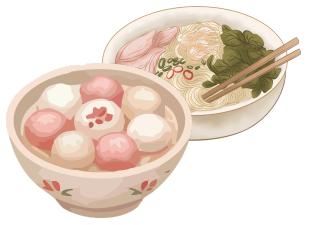
The dishes people eat during Chinese New Year feasts vary, but there are many that are common as a must-have and ones that people avoid. Fish, dumplings, tangyuan, noodles, and fruits are considered important to have during the festival because they are believed to bring luck and prosperity. Long noodles, for example, are said to symbolize longevity. Congee, white-coloured foods, and chopped foods, are generally avoided. Foods that are cut, for example, represent a “cut” fortune.
The 12 Zodiac Animals
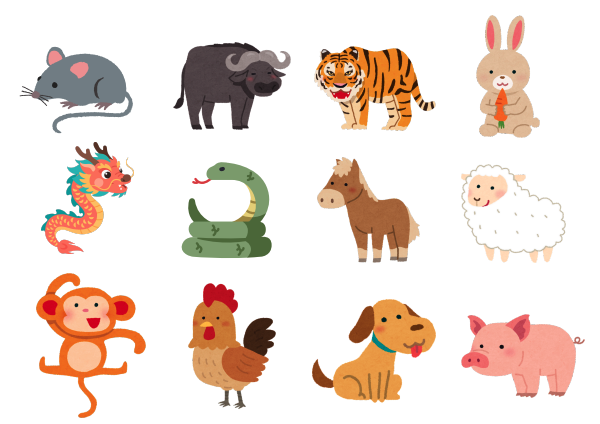
You may have heard of the 12 Chinese zodiac animals. This is important when Chinese New Year is approaching because each year is associated with an animal, which determines the character, predictions, horoscopes, and prosperity of the upcoming year. The most well-known myth that explains the story behind these animals is The Great Race. The Jade Emperor wanted to organize a race with various animals to create a way to measure time. The first 12 to cross the river would earn a spot on the zodiac calendar in the order they finish the race.
The rat wanted to start early, but on the way to the river, the rat met the horse, the tiger, and the ox. Since the rat was small and not good at swimming, he asked these bigger animals to help. Luckily, the ox kindly offered to help and carried the rat on his head while swimming across the river. Just before finishing the race, however, the rat leaped forward and took first place. The ox followed just after, and the tiger finished in third place. The rabbit had to hop on the rocks to make it across, but managed to come into fourth place. The dragon was able to fly across, but stopped to help other creatures along the way, causing it to place fifth. Just as the horse was about to finish the race, the snake slithered through and startled the horse, placing sixth, with the horse following in seventh place. The sheep, the monkey, and the rooster crossed the river on a raft and worked together to get through any obstacles. The three animals agreed to give eighth place to the sheep because it was the most peaceful and comforting, followed by the monkey and the rooster. The dog came in eleventh; even though he was great at swimming, he spent so much time playing in the water that he nearly came last. The final spot was claimed by the pig, who ate and took a nap before finally crossing the finish line.
How Chinese New Year is Being Celebrated Across Canada
Roughly five percent of Canada’s population is Chinese, which is why Chinese New Year festivities can be seen in urban centres across Canada. However, it can sometimes be difficult for Chinese Canadians to have a proper celebration for Chinese New Year, especially since many still have relatives abroad and the New Year is meant to be a large family gathering, but this does not put a stop to the celebration!

Major cities in Canada, especially the Chinatowns within the cities, organize banquets, performances, and family activities. In Calgary, the Asian Heritage Foundation (AHF) is partnering with the Calgary Public Library to provide a diverse program of cultural performances, booths, and crafts for people to experience and learn more about Lunar New Year traditions. Toronto is hosting a Dragon Ball, which is the annual benefit gala for Yee Hong Community Wellness Foundation and has become one of the largest Chinese New Year celebrations of its kind in North America. Vancouver will be having its 52nd annual Chinese New Year Parade. Finally, Montreal has a variety of immersive and artistic events, including the Magic of Peking Opera, where you can experience China’s most iconic theatre at L’Octogone Library.
In smaller rural areas, it can be even more challenging to celebrate Chinese New Year, and the occasion is less likely to be recognized by towns if they only have a few families that celebrate it. However, they still find unique ways to celebrate as well as spread their traditions and teach non-Asian families about it. In Fort Macleod, Alberta, for example, the church invited a local Chinese individual to host and teach people how to eat hot pot.
Customs and Superstitions
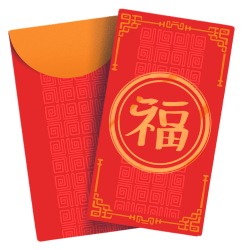
- Red pockets, or red envelopes, are exchanged during Chinese New Year, as well as other occasions such as weddings or the birth of a child. These red envelopes are filled with money to bring good luck and prosperity. The red color symbolizes good fortune and is believed to ward off evil spirits. Children are often given these red pockets by older family members and relatives, from married couples to unmarried individuals, or even from companies to their employees as part of the business culture. The amount of money given can vary and is guided by local customs and the occasion.
- Before Chinese New Year begins, many people clean their houses to clear out any bad luck or bad spirits. They may also take the opportunity to get a new haircut, buy new clothes, or settle disagreements to start the New Year with good intentions. These practices can be compared to making New Year’s resolutions in Western culture.
- Washing, sweeping, cutting hair, or taking out garbage is not allowed during the Chinese New Year period because it is believed that these actions will wash or throw away good luck from the coming New Year.
- Chinese people also wear red during Chinese New Year for good luck, while wearing black is avoided as it is often associated with death.
Common Misconceptions About Chinese New Year
Chinese New Year is only celebrated by Chinese people.
While Lunar New Year is predominantly known as a Chinese New Year, it is also celebrated by other cultures, such as Vietnamese, Singaporean, and Korean, with some of their own customs. Countries with high Chinese populations have also started adopting Chinese New Year celebrations.
The zodiac animal changes on January 1st.
The zodiac animal does not change until the first day of the lunar calendar, which is different each year.
Interesting Facts
One quarter of the world celebrates Chinese New Year.
Chinese New Year festivals create the world’s largest annual migrations.
Citation: